Why Pin Up Casino Is Blocked in Some Countries

Jake Reynolds
Licensing research · Regulator-tracking since 2020
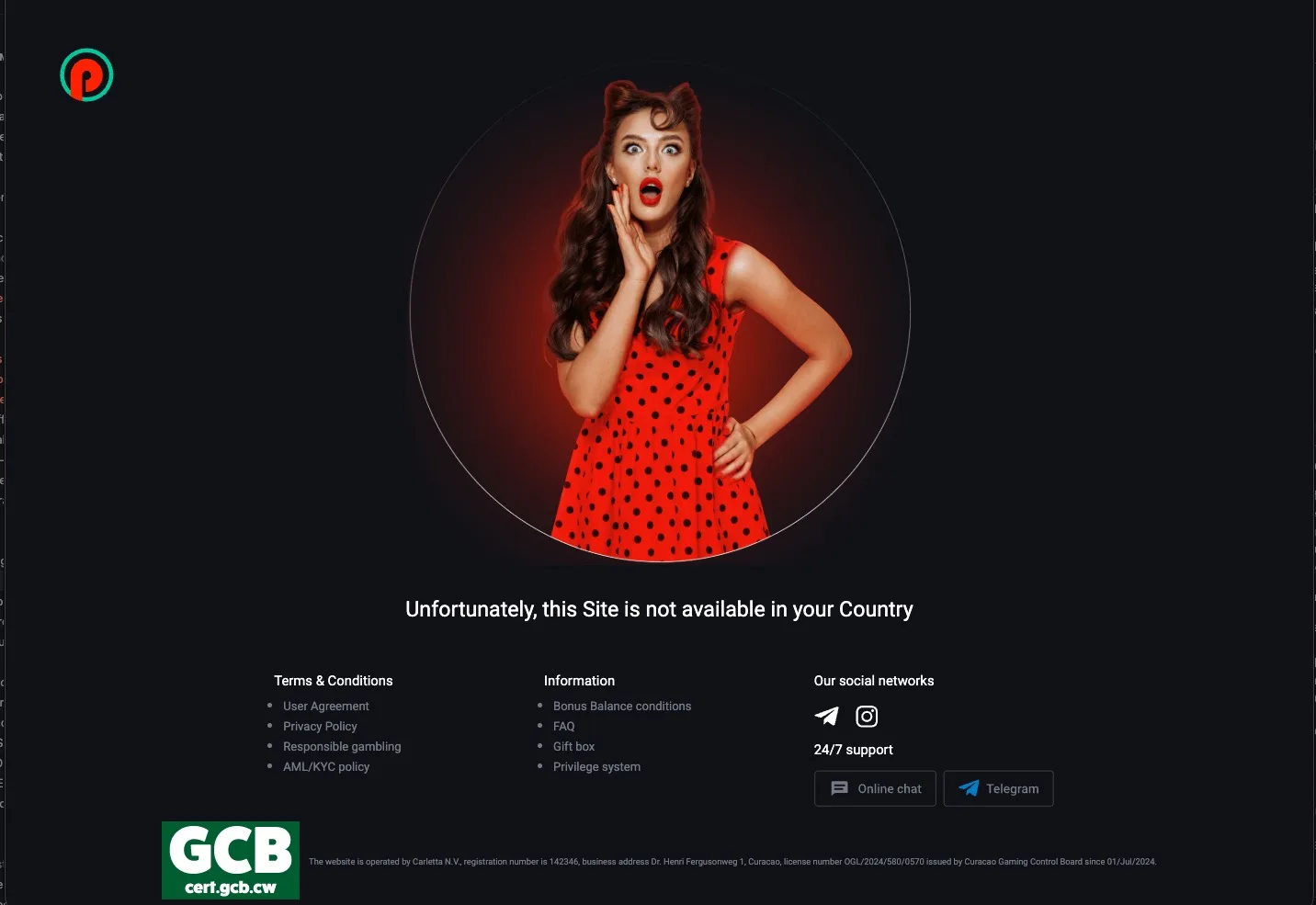 Restriction proof: this is the cleanest user-facing version of a country block message, and it helps separate true market unavailability from the lighter DNS and mirror failures covered elsewhere on this site.
This page is the legal context. No affiliate pitch, minimal CTAs, just the facts about why Pin Up ends up on regulator block lists and what that actually means for you as a player. I'll walk through the Curacao license, the enforcement mechanism, the global legal picture, and the practical question of whether using a mirror puts you at any legal risk.
Last verified: April 11, 2026. License number and regulator references confirmed directly with published sources.
The Curacao License — What It Actually Means
Pin Up holds a gaming license issued by the Curaçao Gaming Control Board (GCB) under number OGL/2024/580/0570. The license was issued in 2024 as part of Curacao's new direct-licensing regime, which replaced the old master-licensing system that had been in place since 1996. You can verify the license number on the Curacao GCB website — that's the official regulator and the only authoritative source for license verification.
License Number OGL/2024/580/0570 — Verified
I checked this license number in January 2026, again in April 2026. Both times it appears in the GCB's active license registry. The license holder is the Pin Up parent operator and the license covers "online gaming activities" under Curacao's gaming legislation (Landsverordening op de kansspelen — the national lottery ordinance that covers online gambling in Curacao). The license doesn't expire annually — it's a multi-year license with periodic compliance audits from the GCB.
If you need to verify a Curacao license for any gambling operator (not just Pin Up), the GCB's public registry is searchable by license number. A real license will show up with the operator's legal entity name, license issue date, and status (active, suspended, expired). Phishing clones that claim to hold "Curacao licenses" sometimes invent license numbers that look plausible — always verify the exact number before trusting any claim.
What Curacao Allows and Forbids
Curacao-licensed operators are permitted to offer casino games, sports betting, live dealer, and poker to players located outside of Curacao, provided they comply with anti-money-laundering (AML), know-your-customer (KYC), and responsible-gambling rules set by the GCB. They are not permitted to offer gambling services to Curacao residents without an additional domestic license, which is a quirk that makes Curacao one of the few jurisdictions whose operators face stricter rules in the home market than abroad.
The GCB's rules also require Curacao-licensed operators to publish their license number prominently in the website footer, maintain dispute-resolution procedures, and submit to audit. Pin Up does all of these — the license number is in the footer of the main Pin Up domain, disputes can be escalated to the GCB via the contact on the GCB website, and audit reports aren't public but are filed with the regulator.
How to Verify the License Yourself
Three steps. Open the GCB website. Navigate to the license registry or operator search page. Enter the license number OGL/2024/580/0570 and verify that the operator name, license status, and issue date match what Pin Up publishes. If any of those don't match, the license claim is false. Note that the GCB occasionally updates its website layout and the exact URL for the license search moves around — if the direct link breaks, start from the root domain and navigate to the regulatory disclosures section.
I maintain a dated screenshot of my most recent verification in the blog. It's good practice to verify any license yourself rather than trusting a third-party claim.
Why Local Regulators Block Foreign-Licensed Sites
A Curacao license is valid under Curacao law. It is not, however, recognized as a "local" license by regulators in India, Russia, Brazil, or most other countries. Each national regulator has its own rules about what constitutes a legal gambling operator for its residents, and a foreign-licensed site almost never qualifies without an additional domestic license. Three main reasons drive this.
Tax Revenue Reasons
Domestic-licensed gambling operators pay taxes to the national government. Foreign-licensed operators that serve a country's residents don't — their tax base is in Curacao (or Malta, or wherever they're licensed). Governments don't like unlicensed operators because they represent uncaptured tax revenue, which is why the first reaction to a foreign operator's popularity is usually to block the URL and force players to domestic alternatives that do pay tax.
Player Protection Reasons
The stated reason for most blocks is player protection — the argument that foreign-licensed operators don't meet local consumer-protection or responsible-gambling standards and therefore put players at risk. This is partly true and partly a rationalization. Curacao's standards are lower than EU or UK standards in specific areas (dispute resolution speed, for instance) but higher in others (advertising restrictions). Whether that matters to any individual player depends on what they care about.
Domestic Operator Lobbying
The unspoken reason. Domestic gambling operators who pay for local licenses lobby their regulators to crack down on foreign competition. This is visible in the timing of block actions — they often follow organized complaints from local operator associations. India's 2023–2024 wave of online gambling blocks coincided with lobbying from Indian fantasy-sports operators who wanted to clear competitive space. Brazil's 2026 Anatel notices followed the launch of a local regulator that issues domestic licenses and has an incentive to promote license-holders over foreign operators.
None of this is unique to Pin Up — it happens to every foreign-licensed online gambling operator in every market with a competing local industry.
How Blocks Are Enforced
Three main enforcement mechanisms, in increasing order of bypass difficulty.
DNS-Level Blocks (Easiest to Bypass)
The ISP's DNS resolver refuses to return an IP address for the blocked domain. Your browser asks "where is pinup-example.com?" and the resolver says "no record" even though the record exists. Switch to a public DNS (Cloudflare 1.1.1.1 or Google 8.8.8.8) and the lookup succeeds — the block is bypassed in about two minutes with no special tools. Most country-level Pin Up blocks I track are DNS-level. Step-by-step DNS swap instructions are in the troubleshooting guide.
IP-Level Blocks
Harder. The ISP null-routes traffic to specific IP addresses at the carrier edge, so even if DNS works your packets never reach the destination. Bypassing IP blocks requires either a VPN (which reroutes your traffic through a different exit country) or an app that uses fallback IPs outside the blocked range. The Pin Up Android app is designed around this — it ships with multiple fallback domain/IP pairs and rotates at login. Grameenphone's March 22 block was IP-level and the app was the only reliable workaround.
Deep Packet Inspection (Hardest to Bypass)
The heaviest mechanism. The ISP inspects the content of HTTPS handshakes using Server Name Indication (SNI) and blocks connections whose SNI matches a banned domain, even if DNS and IP routing would otherwise succeed. Bypassing DPI requires either encrypted SNI (ESNI/ECH, which is still not universally deployed) or a VPN that tunnels all traffic inside a single encrypted stream that DPI can't inspect. Russia's RKN uses DPI on some backbone equipment, which is why Russian access is harder than any other market I track.
Is Using Pin Up Legal If My Country Blocks It?
The short answer is "in most countries, yes — playing is legal, operating without a local license is illegal." The distinction matters. Regulators generally pursue operators, not individual players. I'm not a lawyer and this isn't legal advice — always check your specific jurisdiction — but here's the pattern I see across the markets I track.
Player Liability vs Operator Liability
In India, the Public Gambling Act (1867) and state-level gambling laws criminalize operating a gambling house without a license but are largely silent on player participation in foreign-licensed online gambling. Some Indian states (Telangana, for instance) have passed state laws that also penalize players, but enforcement is almost entirely against operators. Federal-level enforcement against individual players is essentially nonexistent.
In Russia, gambling law restricts operation to four designated "gambling zones" (Sochi, Krasnodar, Primorsky, Crimea, and Kaliningrad — essentially casino resort regions), but player-side use of foreign operators isn't directly criminalized. RKN blocks the URLs as content enforcement, not because playing is illegal.
In Brazil, gambling law is in transition. A 2023 federal law regulated sports betting and online gambling with a domestic licensing framework, and enforcement against unlicensed foreign operators started in 2024. Players using foreign operators aren't typically pursued, but deposits may face friction from domestic banks that have to comply with anti-money-laundering checks.
Real-World Enforcement Examples
I don't have any examples of individual players being prosecuted in India, Russia, Brazil, Bangladesh, Kazakhstan, or the other markets I track. The enforcement model is: regulator blocks the URL, player responds by using a mirror or VPN or app, cycle repeats. Nobody gets arrested because they played slots on a foreign-licensed site from a home broadband connection. The friction is purely accessibility, not legality.
The WTO's 2005 ruling in the Antigua-vs-USA case on cross-border gambling established the principle that countries can regulate gambling but must do so consistently across domestic and foreign operators — they can't selectively allow their own operators while blocking foreign ones without a valid public-interest rationale. The ruling hasn't been enforced in practice (the US lost the case and ignored it), but it's a standing reference in cross-border gambling law. The WTO website has the full case summary.
What Pin Up Does to Stay Accessible
Pin Up's response to block enforcement is a standard mirror-rotation strategy that most foreign-licensed operators use. Three tools.
Mirror Rotation
Pin Up registers new domains continuously and routes a subset of traffic to each. When a mirror lands on a regulator's block list, it gets retired and traffic shifts to a fresh domain. The rotation happens weekly or faster during heavy enforcement periods. I track roughly 30 active mirrors across 7 countries — that number is stable because Pin Up retires about as many as it registers per month.
The Telegram Channel
Pin Up runs an official Telegram channel that broadcasts current working mirror URLs to subscribers. When a new mirror launches, the channel posts the URL. When an old one dies, users can ask the channel bot for a current working one. This is how Pin Up maintains a communication channel with users that doesn't depend on the main website being reachable.
The Android app has its own update channel that pushes new fallback domains into the app binary without requiring a manual user update. This is why the app survives block events that take down every web mirror simultaneously — its connection targets are baked into code, not loaded from DNS.
Responsible Access Note
Before wrapping this page: even though using foreign-licensed gambling sites is legal for players in most jurisdictions, it still carries all the normal risks of online gambling. Curacao's player-protection standards exist but are lighter than EU/UK standards in specific areas. Always play within your budget, use Pin Up's deposit-limit tools, and check responsible gambling resources if you're worried about your own play. BeGambleAware and GamCare are both international helplines with confidential support.
Last verified: April 11, 2026. License number and regulator references cross-checked with published sources.
Jake Reynolds
6 years researching gambling regulation and cross-border access. Independent — no retainer from Pin Up or any competing operator.
Reviewed by Sarah Mitchell — Senior Editor | 15 years in online gaming content
