Responsible Gambling Resources

Jake Reynolds
Site author · This page is the most important one on the site
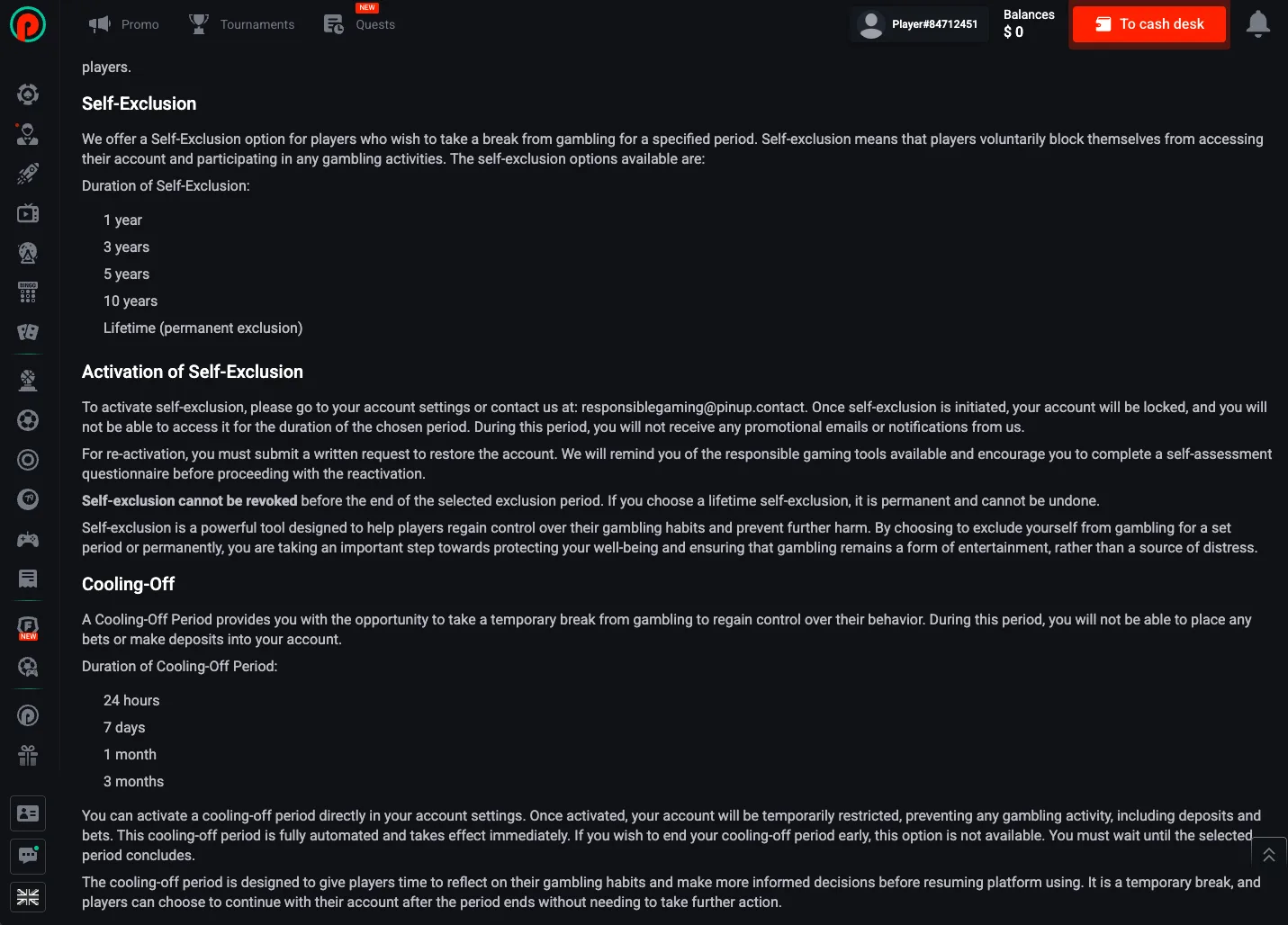 Mirror-site safety proof: even on an access-focused site, the most important destination is still the account-control panel where limits, cooling-off, and self-exclusion can be turned on.
This site exists to help people who've already decided to use Pin Up find a working link. It doesn't exist to recruit new gamblers, argue that gambling is harmless, or pretend the math favors the player. It doesn't. The house always wins over enough time — that's how a casino stays in business. If you play Pin Up, play within a budget you've set in advance, and stop when you hit your limit.
If gambling is becoming something you can't control, the helplines at the bottom of this page are staffed by people who will help you without judgment. No affiliate link at the top of this page, no CTA banner. Just the information.
Last verified: April 11, 2026. All helplines confirmed active.
Signs You May Have a Gambling Problem
Problem gambling doesn't always look like the stereotype. It isn't necessarily losing your rent in a single night. More commonly it's a slow drift — deposits getting larger, losses getting harder to accept, more time spent thinking about the next session than the rest of your life.
Behavioral Signs
- Playing longer than you intended, most sessions
- Chasing losses — increasing bet sizes after a losing streak to "get back to even"
- Hiding gambling activity from family or partner
- Feeling irritable, anxious, or depressed when not playing
- Thinking about gambling when you're supposed to be doing other things
- Lying about how much you've won or lost
- Repeatedly trying to cut back and failing
Financial Signs
- Depositing money you needed for rent, bills, or essentials
- Borrowing to gamble (from friends, family, or credit lines)
- Depleting savings to keep playing
- Missing payments on other bills because the money went to Pin Up
- Selling possessions to fund play
- Taking out new credit specifically to gamble
If more than two items on these lists describe you, it's worth pausing. None of them are proof of addiction but together they're a pattern that tends to get worse over time. Pin Up has built-in tools that help you put brakes on your play — use them before things escalate.
Self-Exclusion Options on Pin Up
How to Request Self-Exclusion
Log into your Pin Up account via any working mirror. Navigate to Account Settings → Responsible Gambling → Self-Exclusion. Pin Up offers cooling-off periods (24 hours, 7 days, 30 days) and longer-term exclusions (6 months, 1 year, permanent). Select the duration you want, confirm with your account password, and the exclusion applies immediately. You won't be able to log back in or place bets until the exclusion period ends.
Permanent exclusion is — as the name says — permanent. Pin Up won't reverse it later even if you change your mind. That's the point. If you're not sure about permanent, start with 6 months and re-evaluate when the period ends.
Cool-Off Periods
The 24-hour and 7-day cool-off options are for situations where you feel like you're losing control in the moment but don't want to commit to a long exclusion. Activating a 24-hour cool-off locks your account for the day. That's usually enough to break a tilt pattern and get some distance from the screen.
Helplines and Support Services
These are the helplines I trust and have verified as active. Most are free and confidential. If you're in crisis, call the one closest to your region first.
Global — BeGambleAware
BeGambleAware.org — UK-based but globally accessible. Free, confidential 24/7 chat and phone support. UK landline 0808 8020 133. Website has self-assessment tools and referral pathways for more intensive support. One of the most thorough resources for English-speaking users.
Global — GamCare
GamCare.org.uk — also UK-based with global reach. Offers structured treatment programs, peer support groups, and family resources for people affected by someone else's gambling. Live chat is available around the clock.
India — iCall
iCall — Tata Institute of Social Sciences psychological helpline. Free email and phone support in English, Hindi, and several regional languages. Phone: +91 9152987821. Confidential counselling including gambling-related issues.
Brazil — Jogadores Anônimos
Jogadores Anônimos is the Brazilian chapter of Gamblers Anonymous. Free peer-support meetings in most major cities plus online groups. Search "Jogadores Anônimos" plus your city name for local chapter contact info. No religious affiliation despite the 12-step format.
Russia — Gambling Therapy
Gambling Therapy — international online support with Russian-language moderators. Free, confidential, and accessible from Russia without special tooling. Forum-style plus 1-on-1 text support.
Setting Deposit and Loss Limits
Pin Up lets you set daily, weekly, and monthly deposit limits. I recommend setting them before your first deposit — it's much easier to set a limit when you're calm than after you've had a losing session. Account Settings → Responsible Gambling → Deposit Limit. Enter your daily or monthly maximum, confirm, and the limit applies immediately. You can decrease a limit at any time; increases take 48 hours to take effect, which is a deliberate cooling-off mechanism so you can't impulsively raise limits mid-tilt.
A good starting benchmark: pick a monthly limit that represents no more than 1% of your gross monthly income. That's "entertainment budget" level — money you can afford to lose without affecting rent, food, or bills. If you find yourself frequently hitting the limit and wanting to increase it, that's a warning sign worth taking seriously.
Time-Out and Cooling-Off Periods
Beyond deposit limits, Pin Up offers session time limits and play reminders. A play reminder pops up every X minutes (you set the interval) showing how long you've been playing and your session balance — useful for breaking time-dissociation during long slots sessions. Session time limits auto-log you out after a set duration regardless of whether you're in the middle of a hand.
Both tools are in the same Responsible Gambling settings panel. Set them once and they apply to every future session.
How Pin Up's RG Tools Work
Pin Up's responsible gambling tools are implemented at the platform level, which means they apply regardless of which mirror you log in from. Set a deposit limit on Monday via mirror-03, try to deposit over the limit on Tuesday via mirror-15 — the limit still blocks the deposit. The same is true for self-exclusion: once activated, no mirror lets you back in until the exclusion period ends.
The tools aren't perfect. They only apply to the Pin Up account they're attached to, so someone who's self-excluded can in principle create a new account. Pin Up's KYC checks are supposed to catch repeat registration attempts but it isn't guaranteed. If you need hard enforcement, the national-level self-exclusion registries in the UK (GAMSTOP), Germany (OASIS), and several other countries cover every licensed operator — those are stricter than any single operator's tools.
Curacao doesn't currently run a central self-exclusion registry for its licensees, which is one of the genuine gaps in the Curacao licensing framework. It's a fair criticism of the jurisdiction. If you need cross-operator enforcement and you're in a country with a central registry, use the central registry on top of Pin Up's individual controls.
If gambling is affecting your life, stop before you keep reading this page. Call one of the helplines above. The people on the other end are trained to help and they won't try to sell you anything.
If you choose to play, do so responsibly — open Pin Up safely
Last verified: April 11, 2026. Helpline numbers and URLs confirmed active.
Reviewed by Sarah Mitchell — Senior Editor | 15 years in online gaming content
